Stronger Medicine?
Too often our belief about healthcare lay in the hands of the doctors only. Not giving much thought about ownership of our own health data management. Live your life and if something doesn’t seem quite right, we instinctively reach for a pill. If the pill is not strong enough, then a call to the doctor is a next best solution. When arriving to his or her office, the expectation is that they’ve studied our medical historical records, that they can reach a quick solution in a matter of minutes and then give us a pill much stronger.
What about this scenario instead, no the doctor has no idea who you are, what your medical history is, nor can a 10 minute-maximum dialog offer enough information for the best of 100s of different solutions. The nurse and doctor tag team, so that the doctor can run to the computer, best case or worst case to written medical protocol texts to find out which prescription best meets your symptoms. Any medication prescribed is better than the ones over-the-counter right? So you might think. When the medication still doesn’t fix your issue, who do you blame? The blaming becomes a vicious cycle, doctors wonder why their patients don’t take better care of themselves. Patients want the doctors to miraculously fix them in 10 minutes, with the right prescription. I am here to inform both of you, you are in need of technology to help you communicate more effectively.
For starters, I will present a technology tool for both of you.
My next blog I will ask you a series of questions to learn more about your perspectives and desires to meet your health goals.
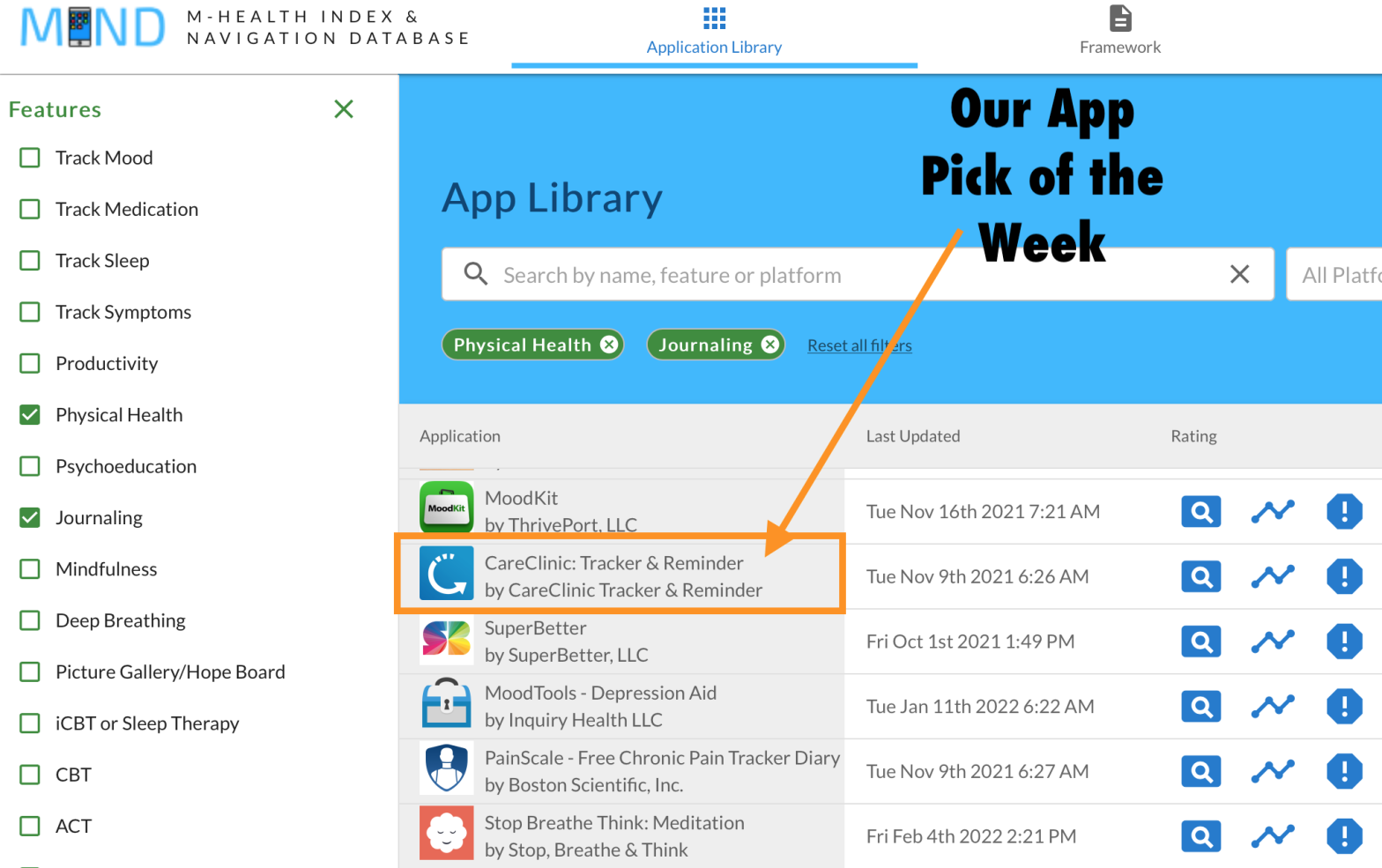
Mind-Health Index & Navigation Database
Explore relevant apps and reviews and search by feature
These apps have been rated based on the following criteria process.
For now what do you think about this apps search tool?
mindapps.org
This team performed the hard work for both the doctor and patient.
“While the APA model provides a useful model through which to consider health apps and make informed decisions, it may be overwhelming for a single clinician during a short clinical visit to attempt to rigorously analyze the many apps that may be relevant to an individual with a particular condition and preferences. To make this framework functional and actionable for the public use, we adapted the questions for inclusion in a database, ultimately including 105 objective questions.
While answering 105 questions about an app is of course not a rapid process, the end product of an easily searchable and updatable database enabling users to immediately sort apps according to the presence or absence of different features relevant to each unique clinical case is appealing. As with the APA model, there is no single score assigned to an app; rather, the database enables customization in consideration of various app aspects. A user of the database will not have to sort through the 105 questions and will instead see an easily interpretable view of app attributes.”
I recommend starting your research for apps to help you engage more effectively with your doctor. Perhaps this apps navigation tool can help fill the gaps between you and your doctor.
Health Data Scientist News Top Health App for this week is: CareClinic
CareClinic is more than an intelligent health tracker and symptom diary, it is your personal best friend and caregiver.
Next time you meet with your doctor, you can simply open your CareClinic app and tell him exactly the what, when and where of your symptoms. Never miss the important details again. Download the CareClinic app on your smart device or desktop.
Written by L.Smith